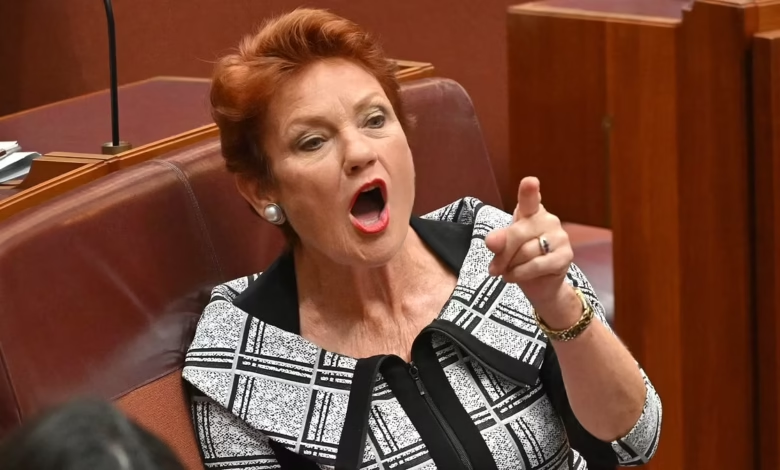
Pauline Hanson remains one of Australia’s most recognizable and divisive political figures in 2025. As the founder and leader of One Nation, her party has recently reached record support levels of 18 percent, reflecting growing public interest in her anti-immigration and nationalist platform.
Just this week, Hanson sparked international headlines when she wore a burqa in the Australian Senate after her bill to ban face coverings was blocked. The incident led to her suspension from Parliament for seven sitting days, marking one of the harshest penalties in Australian parliamentary history.


Whether you view her as a champion of overlooked Australians or a divisive figure promoting harmful rhetoric, understanding Pauline Hanson is essential to comprehending modern Australian politics.
Who is Pauline Hanson? A Political Biography
Early Life and Business Background
Born Pauline Lee Seccombe on May 27, 1954, in Brisbane, Queensland, Hanson’s path to politics was unconventional. She operated a fish and chip shop in Ipswich before entering public life, giving her the “ordinary Australian” persona that would define her political brand.
Entry Into Politics
Hanson’s political career began in 1994 when she joined the Ipswich City Council. She then joined the Liberal Party in 1995 and was preselected for the Division of Oxley in the 1996 federal election.
However, her political journey took a dramatic turn when she made controversial comments about Aboriginal Australians. The Liberal Party disendorsed her shortly before the election, but her name remained on the ballot as a Liberal candidate. In an upset victory, she won the seat as an independent.
Founding One Nation
In April 1997, Hanson co-founded Pauline Hanson’s One Nation with David Oldfield and David Ettridge. The party quickly gained traction among disaffected voters, particularly in regional areas.
At the 1998 Queensland state election, One Nation achieved a stunning result, capturing over 22 percent of the vote and winning 11 seats. This success sent shockwaves through Australia’s political establishment.
The Rise, Fall, and Resurgence of One Nation
The Late 1990s Breakthrough
One Nation’s initial success was unprecedented for a new political party. The movement tapped into concerns about immigration, multiculturalism, and what Hanson described as the neglect of “ordinary Australians” by the political elite.
Former Prime Minister Paul Keating condemned Hanson’s views, stating they projected what he called the face of racism and were deeply divisive to many Australians.
Years in the Wilderness (2002-2014)
Hanson’s political fortunes declined dramatically in the early 2000s. She resigned from One Nation in 2002 amid internal disputes. In 2003, she was jailed on electoral fraud charges, though her conviction was later overturned.
Throughout the 2000s, Hanson made several unsuccessful political comebacks, including attempts to win Senate seats and launching Pauline’s United Australia Party in 2007.
The 2016 Comeback
Hanson officially returned to lead One Nation in 2014. Her timing proved fortuitous. The 2016 federal election marked a surge in support for minor parties, and Hanson won election to the Australian Senate, where she has served since.
Her return included a second maiden speech where she stated Australia was in danger of being overwhelmed by Muslims, shifting her focus from Asian immigration to Islamic immigration.
Pauline Hanson’s Political Views and Platform
Immigration and Multiculturalism
Hanson’s signature issue has always been immigration. In the 1990s, she focused on Asian immigration. Since 2016, her rhetoric has centered on Muslim immigration and Islamic culture.
Hanson has described Islam as a culture and ideology incompatible with Australian values, and she advocates for significantly reduced immigration numbers.
Economic Policies
One Nation promotes economic nationalism and protectionism. Key positions include:
- Supporting Australian industries over foreign competition
- Opposing free trade agreements that disadvantage Australian workers
- Advocating for Citizens Initiated Referenda
- Reviewing politician salaries and pensions
Social and Cultural Positions
One Nation takes conservative stances on social issues:
- Opposition to same-sex marriage
- Skepticism toward climate change policies
- Rejection of critical race theory in schools
- Support for traditional Australian values and culture
The Burqa Ban Campaign
One of Hanson’s most persistent campaigns has been advocating for a ban on the burqa and full-face coverings in public spaces.
In 2017, she first wore a burqa in Parliament to highlight what she called security concerns. On November 24, 2025, she repeated this action after the Senate blocked her bill to ban face coverings.
Following the incident, Hanson was suspended from Parliament for seven days, one of the harshest penalties in Australian parliamentary history. She remained defiant, stating she would let the people of Queensland judge her actions rather than her parliamentary colleagues.
The 2025 Burqa Controversy: What Happened?
The Senate Floor Incident
On November 24, 2025, Hanson attempted to introduce legislation banning burqas and face coverings in public. When the Senate blocked the bill from even being introduced, Hanson returned to the chamber wearing a black burqa.
Foreign Minister Penny Wong condemned the act as disrespectful, noting that all senators represent people of every faith and background. Muslim senators called the display racist and disgraceful.
Parliamentary Response
The Senate suspended for 90 minutes due to the disruption. The following day, a censure motion passed 55-5, with only One Nation senators and independent Ralph Babet opposing it.
The suspension marks the harshest penalty handed down in federal parliamentary history and the first seven-day suspension since 1979.
Hanson’s Defense
In a statement, Hanson defended her actions by noting that more than 20 countries worldwide have banned the burqa due to concerns about women’s rights, national security, and social cohesion. She framed the garment as oppressive to women and a security risk.
Why is Pauline Hanson Still Relevant in 2025?
Growing Electoral Support
One Nation currently holds four seats in the Senate after gaining two in May’s national election. Polling shows the party’s support continuing to grow as the main conservative opposition deals with internal conflicts.
Tapping Into Voter Concerns
One Nation’s platform resonates with Australians concerned about:
- Rising immigration levels
- Housing affordability and infrastructure pressure
- Cost of living increases
- Perceived disconnect between political elites and ordinary citizens
Media Attention
Hanson’s controversial statements and actions generate significant media coverage, keeping her and her party in the public spotlight. Her unscripted, blunt communication style appeals to voters tired of what they perceive as political correctness.
Rural and Regional Support
One Nation particularly appeals to voters in rural and regional areas who feel neglected by major parties. Issues like agricultural policy, water rights, and rural infrastructure feature prominently in the party’s messaging.
Controversies and Legal Challenges
Racial Discrimination Ruling
In November 2024, Federal Court Judge Angus Stewart ruled that Hanson’s tweet telling Greens Senator Mehreen Faruqi to return to Pakistan was anti-Muslim and Islamophobic. Hanson was ordered to delete the tweet, and Faruqi was awarded costs. Hanson is appealing the decision.
Al Jazeera Undercover Investigation
In 2019, One Nation officials were secretly recorded seeking donations from the US gun lobby and discussing weakening Australian gun laws. Hanson condemned the documentary as a politically motivated attack.
Internal Party Disputes
Throughout its history, One Nation has experienced numerous internal conflicts, leadership struggles, and defections. Senator Brian Burston resigned from the party in 2018, and former NSW leader Mark Latham was removed from his position in 2023.
One Nation’s Impact on Australian Politics
Shifting the Overton Window
Regardless of one’s views on Hanson’s policies, One Nation has undeniably influenced national political discourse. Issues the party championed in the 1990s—immigration levels, multiculturalism, and national identity—are now mainstream political topics.
Electoral Mathematics
While One Nation rarely wins lower house seats, its Senate presence gives it significant influence. In a hung parliament, minor parties can hold the balance of power, forcing major parties to negotiate on legislation.
Pressure on the Coalition
One Nation’s rise has created challenges for the Liberal-National Coalition. The party draws support primarily from traditional conservative voters, forcing the Coalition to address issues it might otherwise sideline.
Criticisms and Opposition
Accusations of Racism
Critics consistently label Hanson’s rhetoric as racist and divisive. Political leaders across the spectrum have condemned her views on immigration and multiculturalism.
Australian Greens leader Larissa Waters called Hanson’s burqa stunt disrespectful to people of faith and extremely unsafe.
Concerns About Islamophobia
A government envoy reported in September that Australia has failed to tackle persistent and intensifying Islamophobia. Critics argue that Hanson’s rhetoric contributes to this concerning trend.
Policy Viability Questions
Analysts often question whether One Nation’s policies are practical or economically sound. The party’s protectionist economic stance conflicts with Australia’s export-dependent economy.
Conclusion
Love her or loathe her, Pauline Hanson has fundamentally shaped modern Australian political discourse. From a fish and chip shop owner to one of the nation’s most controversial politicians, her journey reflects deeper currents in Australian society.
Since the 2025 federal election, One Nation has experienced renewed polling success, reaching up to 15 percent and overtaking the Greens. This suggests that the issues Hanson champions continue to resonate with a significant portion of the electorate.
Her recent burqa protest, resulting in a historic suspension from Parliament, demonstrates that even after decades in politics, Hanson remains willing to court controversy to advance her agenda.
Whether One Nation represents legitimate grievances of overlooked Australians or dangerous divisiveness depends largely on one’s political perspective. What’s undeniable is that Pauline Hanson’s impact on Australian politics extends far beyond election results, influencing how the nation debates immigration, national identity, and political correctness.
As Australia navigates complex challenges around immigration, multiculturalism, and national identity, understanding Pauline Hanson—her views, her appeal, and her critics—remains essential for anyone seeking to comprehend the nation’s political landscape.
FAQs
Q: What does Pauline Hanson believe?
A: Hanson advocates for reduced immigration, economic nationalism, traditional Australian values, and policies she claims protect ordinary Australians from global elites and multiculturalism. She opposes what she views as political correctness and Islamic influence in Australia.
Q: Is Pauline Hanson still in Parliament?
A: Yes. Hanson has been a Queensland Senator since 2016 and plans to contest the next election. Despite her recent suspension, she remains in office.
Q: Why did Pauline Hanson wear a burqa in Parliament?
A: Hanson wore a burqa on November 24, 2025, to protest the Senate blocking her bill to ban face coverings in public. She claims the garment oppresses women and poses security risks.
Q: What is One Nation’s current support level?
A: Recent polling shows One Nation at approximately 18 percent support, a record high for the party, as the Coalition deals with internal divisions.
Q: Has Pauline Hanson been convicted of any crimes?
A: Hanson was convicted of electoral fraud in 2003 and served several months in jail, but the conviction was later overturned on appeal.
Read More: Mark Kelly Astronaut, Senator & American Hero Guide 2025